status: mid post-training · reward signal: curiosity · KL penalty: sleep
📈 training history📊 evals🤖 ask
🤖policy
About me
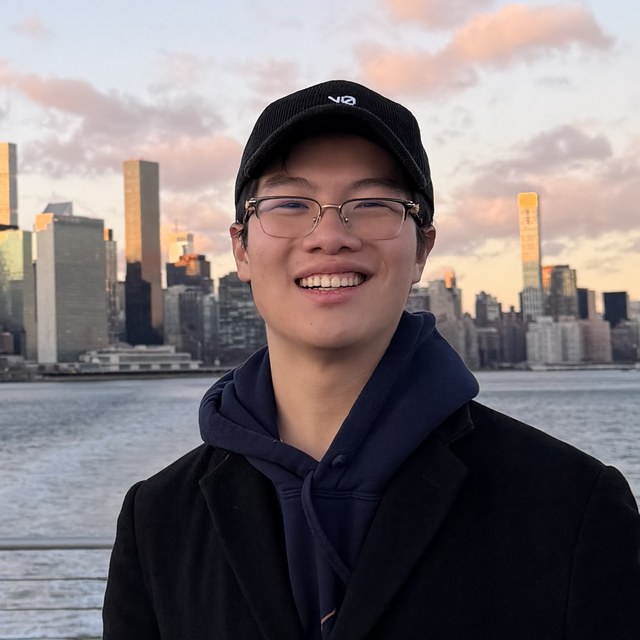
I'm a junior at  Stanford studying Mathematics and Computer Science. I work on reinforcement learning and post-training, and on what those methods do to a model's safety: whether its reasoning stays honest, and which training choices quietly trade oversight for capability. This fall I'm joining
  Redwood Research part-time as an AI safety research intern, after a summer on the Data Platform team at
  Databricks.
I grew up in Hong Kong and went to  Eton College. I sing baritone with the
  Mendicants, Stanford's oldest a cappella group. I speak English, Cantonese, and Mandarin natively, plus some German and beginner Japanese.
🥕reward model
What I optimize for
- Models that stay overseeable as they get stronger. Chain-of-thought monitoring only works if the reasoning we read is the reasoning that drove the answer. I want to know which training choices preserve that, and which erode it while the text still looks fine.
- Post-training that doesn't trade safety for capability by accident. Reward design, distillation, and RL loops each have side effects on honesty and controllability. Those effects should be measured, not assumed.
- Interpretability artifacts wired into training carefully. A probe that is safe to read can be dangerous to optimize against. The access a training loop gives an internal signal should be a deliberate decision.
- Measurements that survive scrutiny. Pre-registered designs, placebo controls, bootstrap intervals, and numbers that regenerate from committed artifacts. A safety metric with a hidden confound is worse than no metric.
∇gradient updates
Research
Three papers are accepted at NeurIPS 2026 workshops: two at InterpScience and one at MATH-AI. Titles, summaries, and PDFs are on the papers page.
What Happens to a Monitor's Accuracy When You Train Against It
A linear probe on a model's hidden states predicts whether its next answer will be correct, with held-out AUROC 0.982. Used as the reward for reinforcement learning, a probe of the same representation drives true accuracy down by 31 percentage points, and the probe's own accuracy does not register the change for about 40 training steps. One statistic, the share of answers above a threshold fixed at the start, registers it early and without ground truth.
How Small Can We Go? Calibrating Activation-Cache Compression for SAE Training
Compressing the activation cache used to train a sparse autoencoder changes which features it learns, but so does perturbing one value in a million by the smallest fp32 step. The paper calibrates each site between retraining on identical bytes and a reseed, then measures codecs against that: naive int4 loses more features than a reseed, and standardizing channels first brings int4 back above the floor at the same file size.
Coding Agents for Coding Theory
Five weeks of an LLM coding agent on open cells of the quaternary edit-metric code table, under a protocol that required verifiers to be written and tested before any search. Searching over codes invariant under a prescribed symmetry group improved thirteen published lower bounds, including E4(6,3) from 114, a bound standing since 2012, to 120. The paper gives equal space to how the work went wrong.
📝rollouts
Projects
A resumable agent that mines recent ML papers, walks the citation graph to find proposed extensions nobody has attempted, and ranks the open problems. SQLite plus vector search, content-addressed caching, best-first frontier.
Agent that evaluates live Polymarket prices and flags mispriced contracts from incoming information and microstructure signals. Finalist at the NVIDIA, Vercel, and Brex hackathon.
 agents · Bridgewater AI Hackathon
Selected as 1 of 24. A multi-agent system that maps causal graphs for policy-impact scenarios by decomposing macro questions into testable sub-claims.
 ai / music · TreeHacks runner-up
Multimodal music coach that analyzes instrument audio and video with NVIDIA vision and audio models. Devpost
BPE tokenizer trainer in Rust with Python bindings. A 32k vocabulary on 12.9 GB of FineWeb in 38 s against 257 s for HuggingFace tokenizers, with every merge byte-identical and a fraction of the memory. GitHub
A language model built end to end in PyTorch: tokenizer, training loop, FlashAttention as Triton kernels, distributed data parallel with optimizer sharding, profiling, scaling laws, and SFT plus GRPO post-training.
LSTM, GNN, and CNN models over 545k+ observations for spatiotemporal air quality forecasting, with robustness testing under distribution shift.
📈training history
Experience
- Sep 2026 – Jan 2027
- Jun – Sep 2026
- Apr 2026 – nowTutor, Center for Teaching and Learning, StanfordOne-on-one appointment tutoring for CS 106A, CS 106B, CS 107, and CS 109.
- Sep 2024 – Jun 2026
 Director of Hackspace, BASESStanford's largest student-run entrepreneurship programs. Sponsor relations and coordination for hackathons serving 200+ participants.
 - Sep 2025 – nowCourse Grader, Applied Matrix Theory, Stanford MathematicsEvaluate proof-based linear algebra for 200+ students.
- Jun – Sep 2025Undergraduate Researcher, Chiu Lab, StanfordBioengineering REU. Built CryoViT, CNN and vision transformer models that segment cell structures in noisy 3D cryo-EM data, applied to Alzheimer's research.
- Jan – Jun 2025Teaching Assistant, Programming Abstractions, Stanford CSLed weekly C++ sections on recursion, complexity, and data structures.
📊evals
Honors
 YC FellowSummer 2026 · mentored by Harshita Arora
- TreeHacks Summer Fellow2026
 MATS 11.0accepted
 Rabi ScholarColumbia University · top 10 scientific admits nationally
- Gladstone Memorial Prize, King's ScholarEton College · valedictorian prize
- PrefectEton College
 British Mathematical Olympiad Round 2top 50 nationally, twice
 UK Chemistry Olympiadgold medal three times · IChO team reserve
 World Science Scholars1 of 48 selected globally
🤖inference
Ask my post-trained self
A small open-weights model with a short bio in its context. Ask it about my work. It can be wrong, so trust the sections above over it.